The Blue Folder

The Blue Folder

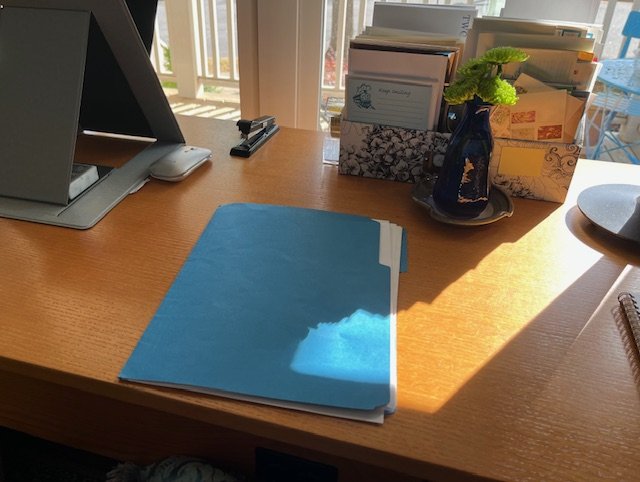
More than 30 years ago, my doctoral advisor handed me two envelopes. They contained identical copies of her recommendation letter for my faculty job applications.  And that day, she surprised me. As she handed me the letters, she said, "One is for your application file. Keep the other for your own file." I must have given her a quizzical look because she added, "In my top desk drawer, I keep a file of things--good reviews of my work, recommendation letters, notes from students. When I'm having a rotten day or doubting myself, I pull that file out to remind me that I do good work and make a difference."


[i] Mind you, I don't remember her exact words, but this is the gist of my takeaway from the conversation.
Don't Run from Negative Emotions

Don't Run from Negative Emotions

Let's face it: none of us likes feeling sad, frustrated, angry, or any of the other emotions that we label as negative. We are steeped in a culture of positivity--even toxic positivity--that encourages us to maintain a positive mindset no matter how difficult our lives might be in any given moment. As a result, we often go to great lengths to hide from negative feelings. We lose ourselves in work, mindlessly watch Tik-Tok videos, binge-stream television shows, or overindulge in food or in mind-altering substances--anything that will help us ignore the hard emotions.

But none of our escape strategies change the underlying situation that is creating the negative emotions.

Building Your Systems

Building Your Systems

Writer James C. Clear says in his book Atomic Habits, "Goals are about the results you want to achieve. Systems are about the processes that lead to those results." He goes on to say that "Goals are good for setting a direction, but systems are best for making progress." He reminds us that winners and losers have the same goals. It's not the goal that drives the outcome; it's the system. Each year I become more convinced that systems are really the key to tackling big projects.

Mentors, Sponsors, and Peers

Mentors, Sponsors, and Peers

Mentoring comes up a lot in coaching. Many clients are seeking professional mentors, and others are striving to be good mentors for teammates or students. We usually think of mentors as more experienced colleagues who can advise us and foster our professional development. Relationships with mentors are built on mutual respect and trust. But mentors are not the only relationships that professionals need to cultivate.

Trust

Trust

When you think about it, the very foundations of daily life rest on trust. Every time we get in the car, we trust that most drivers will operate vehicles safely and according to traffic laws. We trust that our physicians will do their best to provide us with good medical care. We trust that the police officer who pulls us over for speeding will treat us with fairness and respect. We trust that the check-out clerk at the supermarket will not cheat us. In short, in order to move through the world most effectively, we must trust that most people are acting on good faith and doing the best they can.

Balance

Balance

Balance. When I begin work with new coaching clients, I ask them to set three to five goals for our work together. The word balance almost always appears somewhere in each client’s list of goals: “Live a more balanced life.” “Create more work-life balance.” “Find a better balance between work and play.” “Balance my own needs with those of everyone

My Favorite Reads from Last Year

My Favorite Reads from Last Year

Last year I shared my favorite reads from 2023. It was one of my most read blog posts, so I decided to do the same again. One of my goals for this third chapter of my career was to make more time for reading, and this proved to be a record-breaking reading year for me. Including audio books, I read over 100 books! (Thank goodness for audio books.)

 I was able to quickly choose my top 20, but it proved nearly impossible to narrow it down further. Instead I decided to focus on ten lesser-known titles that I think are likely to appeal to you, dear reader.

Hope in the Dark

Hope in the Dark

I’ve always made it a point to avoid politics in my writing for the Heyday blog.  This month, I even considered not doing a newsletter. I don’t have any words of wisdom. I also know that not all my readers are on the same political page.


But I believe that compassionate people, no matter who they voted for, recognize that this is a deeply painful time in our national life.  And somehow it felt dishonest and inauthentic not to talk about what is on my mind—and everyone else’s. Especially when so many people are hurting and frightened for the future. When so many people fear for their own safety and that of loved ones.


Eventually I realized the best way I could be of service might be to share some of the resources I’m turning to for comfort, hope, and wisdom in this uncertain time.


Manage Your Energy

Manage Your Energy

Time scarcity is real. We repeatedly ask ourselves or are asked by others to do more than is humanly possible in any given timeframe. Most of us can learn to use our time more effectively by reducing distractions and improving our focus. But no matter how good we get at reducing demands and managing our time, it seems that over and over, we end up feeling the pressures of time scarcity. We must also learn to manage energy as well as time. 

Three Books I Wish I Had Read in My Thirties

Three Books I Wish I Had Read in My Thirties

I just finished an audiobook that is full of wisdom about effective communicating. I wish I had read this book in my thirties when I was just beginning to think seriously about assembling a toolkit to navigate my career (and the rest of my life) more successfully. (Alas, the book was just published.) Thinking about that made me think about a couple of other game-changing books I could have used thirty years ago.  So here just in time for summer reading season (or road trip audiobook season) are three titles you might want to check out.