
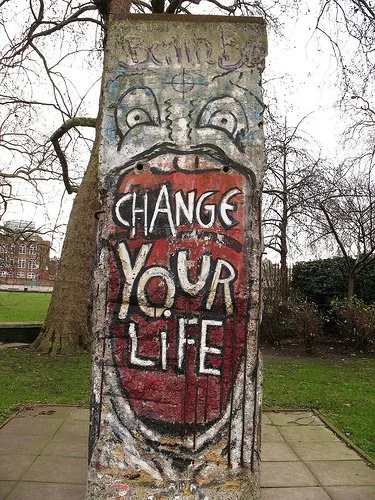

Section of the Berlin Wall now displayed at the Imperial War Museum in London. Photo copyright 2007 by Chuck Reback.
I've been thinking a lot about the question of how our attitudes about the world shape our experience of life. That mental rabbit hole led me back to something women's suffrage leader Elizabeth Cady Stanton said. In an earlier post on Substack, I wrote about Stanton's seventieth birthday speech, the occasion when she said that "fifty not fifteen is the heyday of woman's life."
That day Stanton told her audience about two hypothetical women and their responses to life at every age. One young woman was “a beam of sunshine. . . with her own glad outlook on life” while the other was “a discontented girl." Stanton said that the discontented girl grew "more and more unhappy as the years roll[ed] round.” Stanton suggested that the young woman who had approached life with vitality and curiosity would take the same approach to the second half of life while the restless and discontented young woman would grow bitter in her middle and later years.
Is Stanton correct? Does the mindset we have as young people determine how we develop as we grow older? Or can we change the habits of mind that obstruct satisfying lives? That's a question my coaching clients and I also wrestle with.
Stanton did not discuss the forces that might lead people to develop a negative outlook. In the nineteenth century, when women had few political, legal, or economic rights, many women were powerless to control their own destinies. In today's world, American women enjoy a broader array of opportunities to pursue satisfying lives. Yet many clients have experienced profound damage that convinces them they are powerless to change their circumstances. As I've written before, these clients struggle to distinguish between the limits they impose on themselves and those that are imposed from the world around them.
Several years ago, a client deeply frustrated with her career signed on for coaching. Jennifer (not her real name) had earned a Ph.D. at one of the country's most elite universities, and she had landed a tenure-track faculty job, an increasingly rare opportunity in higher education.
Yet Jennifer's job was unsatisfying. She was rarely able to teach courses in her own specialty. A heavy teaching load prevented her from doing the research that was key to keeping her job in the long-term, something her department chair regularly reminded her. She was living in a large, expensive, car-centered city where she had few friends and spent many hours a week commuting.
Jennifer's paralysis was rooted in her past. She had weathered a nit-picking, fault-finding graduate school advisor who did more to tear her down than to encourage her. Other experiences in her childhood and youth had injured her sense of herself as a capable person.
With each new opportunity that came her way, Jennifer's graduate advisor's relentless criticisms echoed in her head. Instead of applying for jobs, she endlessly polished her c.v. (the academic version of a resume) and her job application materials. She let deadlines pass without submitting applications, convinced that she was not good enough for a new role.
I couldn't deliver a secret potion to transform Jennifer's outlook, but I could offer tools to help Jennifer quiet her advisor's berating voice in her head. I asked her to do some reading and complete reflection exercises designed to reveal the ways that she was imposing limits on herself. It was hard work, and Jennifer kept at it.
One key that unlocked the future was reading psychologist Carol Dweck's work on developing a growth mindset. Jennifer began to believe that she could stretch into new roles instead of being limited because of fixed set of intelligence and skills. That shift enabled her to approach new challenges with a spirit of "what can I learn from this?" and see setbacks as just another step on the road to career development.
Jennifer and I worked together about six months. By the time we finished, she had landed a research opportunity in the East Asian country she studied. Jennifer happily embraced this new adventure. A couple of years later, she landed a university teaching job in the same country. The last time we communicated, Jennifer has work and a life she loves.
My research on aging women for The Heyday of a Woman's Life also offers insights into whether and how we can change our attitudes in ways that help us move beyond paralysis.
Some women I studied did indeed become "more unhappy as the years roll[ed] round." For example, civil rights activist Jessie Daniel Ames, scarred by her father's indifference, her unhappy marriage, her struggles as a single mother, and the unsatisfactory ending of her career, "spent too many years, almost all that I have lived, building up a stone wall between me and the people whom I love." The result was deep unhappiness and isolation as she aged.
But other women became happier and more vital as they grew older. Like Ames, psychologist Ida Davidoff endured an unhappy childhood that eroded her self-confidence and sense of agency, but in middle age, therapy launched her journey to a thriving career and a happy life. Olive Damon overcame years of misery with her alcoholic, philandering husband to claim an independent identity as artist, writer, and businesswoman. Encouragement from friends and her son proved crucial to Olive's transformation.
The examples of Jennifer, Jessie Ames, Ida Davidoff, and Olive Damon teach us that changing the habits of mind that limit us requires at least two things. First, we must be willing to do deep inner work. Second, we must seek and maintain connections with people who will encourage and support us.
What else would you add to this list? How have you succeeded in changing your mindset when you get stuck?